How to check a packaging dieline with a paper prototype
A practical method for verifying the orientation of the lid, the glue flap, and the sequence of the panels on a cardboard box before proceeding to print.
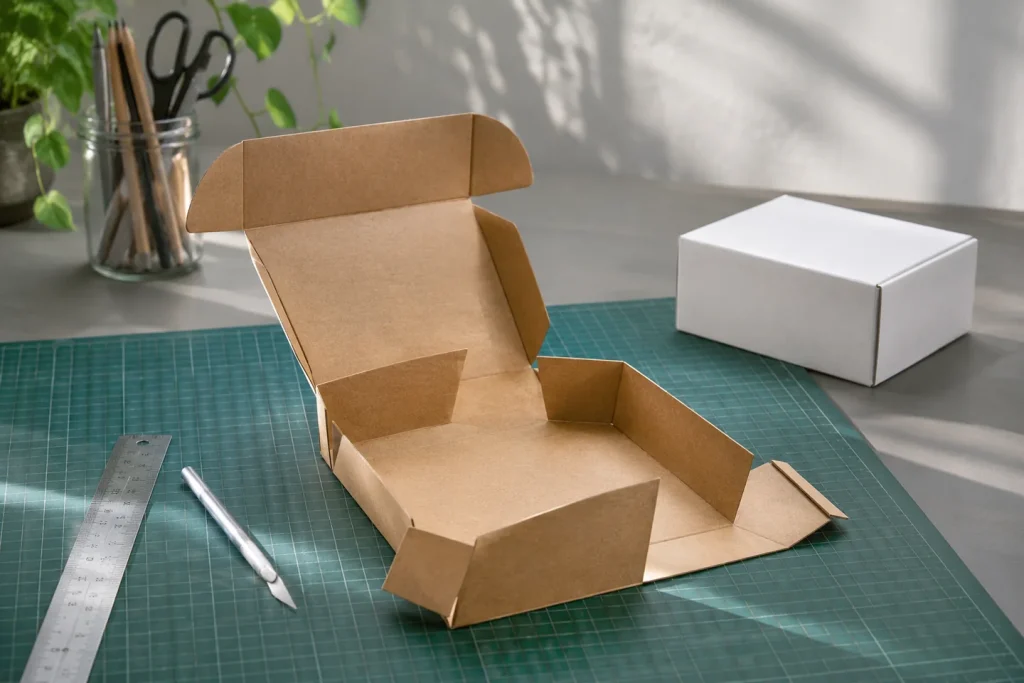
In the unfolded layout, the front and back faces appear side-by-side. On a retail shelf, however, a customer first sees the front face, and upon picking up the box, they see a side panel. It is therefore not surprising that a heading—which appears correctly oriented on the flat die-cut layout—might end up upside down on the finished box. One must examine the flat design and the folded box as two distinct entities.
Fold an empty box at actual scale.
Request the latest die-cut drawing from the manufacturer. Print it at 100% scale, number the panels, and use arrows to indicate their top orientation. Once the box is folded, it becomes immediately clear which panels align with one another. Also, mark the area that is revealed first when the lid is opened. If any text falls onto the glue flap, you can relocate it before finalizing the design.
A paper mock-up, cut and assembled by hand, is sufficient for verifying panel orientation. To determine whether the box can support the weight of the product or how tightly the lid will close, you will need a sample made from the actual production-grade cardboard. Keep a record of the drawing version and the date the sample was created within the same project file.